



Have a Question?
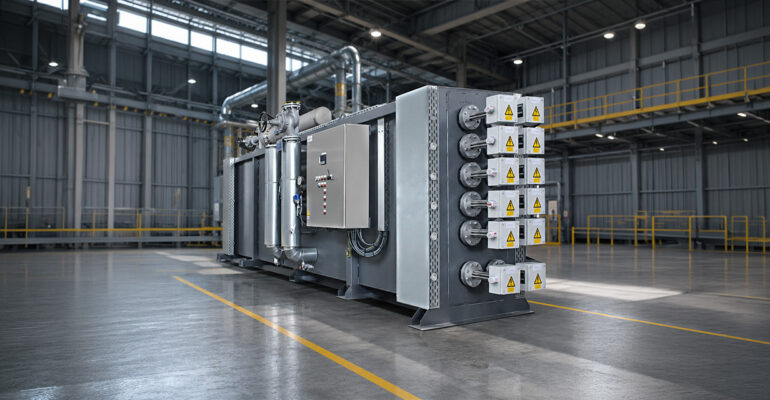
Electric Thermal Fluid Heaters for Precise Industrial Process Heat
AURA designs and manufactures custom electric thermal fluid heating systems for industrial processes that require stable high-temperature heat without on-site combustion. Each system is engineered around your heat load, temperature profile, electrical infrastructure, control requirements, installation constraints, and lifecycle goals.
As electric process heat gains momentum in the U.S., AURA brings proven experience in complete electric thermal-fluid systems — from thermal calculation and controls to in-house manufacturing and lifecycle support.
40+ years in process heat | 6,000+ installations worldwide | 400+ systems delivered to the U.S.
ASME S & U | National Board | German in-house manufacturing
Why Electric Process Heat Is Growing in the U.S
More and more North American manufacturers are evaluating electric process heat to reduce on-site combustion, simplify installation, improve temperature control, and support electrification-driven plant strategies. For many suppliers, electric thermal-fluid heating is still an emerging capability. For AURA, it is a proven area of expertise.
AURA has extensive experience designing and manufacturing electrically heated thermal-fluid systems for demanding industrial applications. Our systems are not standard heater packages. They are engineered around heat load, temperature profile, electrical infrastructure, hot oil flow, controls architecture, installation constraints, and long-term operating requirements.
What is an Electric Thermal Fluid Heater?
An Electric Thermal Fluid Heater transfers heat generated by electric heating elements into circulating thermal fluid through a controlled heat exchange process.
The heated thermal fluid is then circulated through connected industrial equipment and processes requiring stable high-temperature heat.
AURA systems are individually engineered based on temperature requirements, operational conditions, and process integration needs to ensure efficient and reliable performance.
System Properties
- Type of Heating: Electric
- Consumer Medium: Thermal Fluid
- Temperature Range: Up to 842°F
- Power Range: Up to 20,000 kW / 68.24 MMBtu/h and more
Electric thermal fluid systems provide stable high-temperature process heating without the need for combustion systems or fuel handling infrastructure.
Operating Principle of Electric Thermal Fluid Heaters
An electric thermal fluid heater uses electric resistance elements to heat circulating thermal fluid within a closed-loop system. The heated thermal fluid transfers indirect process heat to equipment such as reactors, dryers, extruders, presses, ovens, calender rolls, and process vessels.
After releasing its heat to the process, the hot oil returns to the heater at a lower temperature, where it is reheated and recirculated. The system maintains precise temperature control through temperature sensors, flow monitoring, staged or modulating heat output, safety interlocks, and integrated control systems.
The process includes:
- Electrical energy is converted into heat through electric resistance heating elements.
- Thermal fluid absorbs the heat inside the heater vessel.
- A circulation pump moves the hot oil through the process loop.
- Heat is transferred indirectly to the industrial consumer.
- The cooled fluid returns to the heater for reheating.
- Control and safety systems regulate operation based on temperature, flow, pressure, and process demand.
Technical Advantages of Electric Thermal Fluid Heating
| Feature | Why It Matters |
|---|---|
| No Burner or Fuel Train | Requires significantly less maintenance than fired systems and eliminates fuel-handling requirements. |
| No Flue-Gas Path | Eliminates stack losses and local combustion emissions. |
| Electric Resistance Heating | Converts electrical energy directly into heat at the heater, enabling 100% energy conversion efficiency at the point of use. |
| Thermal Fluid Heat Transfer | Delivers high process temperatures at lower operating pressures compared to steam systems. |
| Precise Output Control | Provides accurate temperature regulation and improves process consistency and repeatability. |
| Compact System Layout | Ideal for installations where space is limited or indoor placement is required. |
| Plug-In Flanged Heaters | Simplifies maintenance and allows easier heater replacement when needed. |
| Optional Direct Heating/Cooling Configuration | Can streamline temperature-control architecture depending on process requirements. |
| Explosion-Proof Design (Optional) | Suitable for selected hazardous-area applications, subject to project-specific review and certification requirements. |
| Custom System Engineering | Integrates heater, circulation pump, controls, safety devices, and documentation to match specific process needs. |
Nearly all electrical energy supplied to the heater is converted into useful heat, minimizing combustion-related losses. Actual operating costs depend on site-specific factors including electricity tariffs, demand charges, operating schedules, load profile, and the cost of alternative fuels.
Best Fit When
An electric thermal fluid heater is a strong fit when the process benefits from precise temperature control, no on-site combustion, compact installation, and an electrification-focused energy strategy. It is particularly well suited for facilities with sufficient electrical capacity or those planning electrical infrastructure upgrades as part of modernization initiatives.
- Precise Control is Required
Stable temperatures and accurate process performance. - No On-Site Combustion is Preferred
Eliminates burners, fuel systems, and flue-gas emissions. - Electrical Infrastructure is Available
Ideal where adequate power capacity exists or is planned. - Space is Limited
Compact footprint supports indoor and constrained installations. - Reduced Maintenance is Desired
Fewer combustion-related inspection and service requirements. - Electrification is a Priority
Supports lower on-site emissions and energy-transition goals. - Direct Heating & Cooling is Beneficial
Can simplify temperature-control architecture in selected applications.
Typical AURA System Scope
Depending on the application, an AURA electric thermal fluid heater can be supplied as a complete engineered system, with the scope tailored to process requirements, installation conditions, control philosophy, and applicable codes and standards.
Typical scope may include:
- Heater vessel and electric heating elements
- Circulation pump and pump skid
- Expansion tank and thermal-fluid management system
- Temperature, pressure, and flow instrumentation
- Safety interlocks and shutdown logic
- Control cabinet and process integration
- Optional cooling circuit
- Skid-mounted functional units
- Piping interfaces and integration support
- 3D layout and engineering drawings
- ASME/National Board documentation, where applicable
- Documentation package and commissioning support
Applications
- Calender and Roll Temperature Control
For nonwovens, textiles, paper, film, and finishing processes requiring precise roll temperature stability. - Press Heating and Cooling
For plastics, composites, rubber, wood, and industrial forming applications requiring uniform temperature control. - Extruder and Polymer Process Heating
For controlled thermal-fluid circuits in plastics and polymer manufacturing. - Dryers and Ovens
For industrial drying and curing processes requiring stable indirect heat. - Reactors and Agitator Vessels
For chemical and process applications requiring precise indirect heating. - Food Processing and Clean Production Areas
For hygienic applications where compact, clean, and combustion-free operation is preferred.
Key Features
- Electrically heated thermal fluid systems
- High-precision temperature control
- Low-pressure, high-temperature operation
- Custom-engineered system configurations
- Integration with process and control systems
- Robust construction for industrial environments
- Optimized for reliable continuous operation
Applications
- Chemical processing
- Plastics and polymer manufacturing
- Nonwoven production
- Food processing industries
- Pulp & paper operations
- OEM and industrial process systems