



Have a Question?
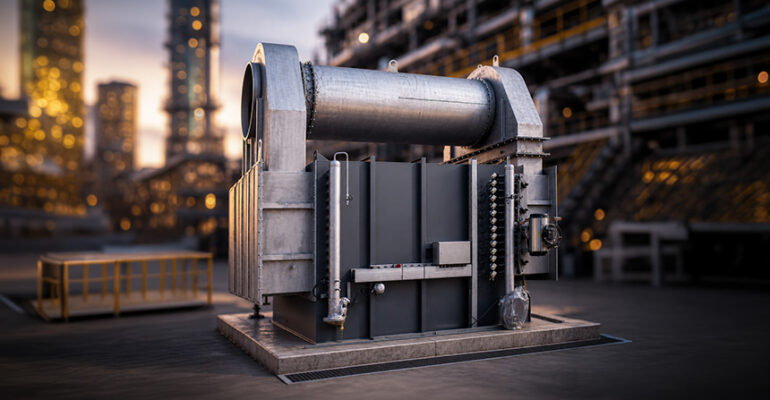
Waste Heat Recovery Units for High-Capacity Exhaust Energy Recovery
Industrial processes and energy generation systems release large amounts of thermal energy through exhaust and flue gases. In many facilities, this heat is discharged unused into the atmosphere, resulting in energy loss and increased operating costs.
AURA Waste Heat Recovery Units (WHRU) are designed to capture this unused thermal energy and convert it into usable process heat, improving overall efficiency and supporting more sustainable industrial operations.
By recovering and reusing waste heat, industries can significantly reduce fuel consumption, lower CO₂ emissions, and optimize energy utilization across processes.
System Properties:
- Heat source: Flue gas / exhaust gas / turbine exhaust
- Typical source conditions: Project-specific; high-temperature exhaust streams, up to final approved value
- Output medium: Thermal fluid, steam, hot water, or air depending on system design
- Thermal-fluid temperature: Up to 842°F
- Output Range: Up to 20,000 kW / 68.24 MMBtu/h
Best Fit:
- Gas turbines,
- Large exhaust volumes,
- Offshore/process-Energy applications,
- Multi-use heat recovery
Operating Principle of Waste Heat Recovery Units
Industrial turbines and process systems generate exhaust gases with temperatures often ranging between 752° and 1112° or higher. AURA WHRU systems recover this thermal energy through a controlled heat transfer process.
The process includes:
- Hot exhaust gases are directed into the Waste Heat Recovery Unit
- The Waste Heat Recovery Unit transfers the thermal energy to a secondary medium such as thermal fluid, steam, or water
- The heated medium is supplied into an industrial process
- Exhaust gas temperatures are reduced in a controlled and energy-efficient manner
Each system is precisely engineered based on:
- Exhaust gas temperature
- Volume flow rate
- Pressure conditions
- Process heating requirements
Your Advantages at a Glance
Key Features
- Custom-engineered waste heat recovery solutions
- High-efficiency heat transfer systems
- Integration with existing industrial infrastructure
- Compatible with thermal oil, steam, and hot water systems
- Robust design for continuous operation
- Optimized for maximum energy recovery and efficiency
Applications
- Crude oil processing
- Offshore platforms
- Power generation systems
- Refineries
- Chemical production facilities
A Waste Heat Recovery Unit is the right fit when:
- A large, stable exhaust or flue-gas stream is available for heat recovery.
- The heat source originates from gas turbines, combustion systems, industrial furnaces, reciprocating engines, or other high-temperature process exhaust streams.
- Thermal fluid, steam, hot water, or heated air are being evaluated as the preferred heat-transfer medium.
- The project offers significant energy recovery potential, justifying a fully engineered waste heat recovery solution rather than a standard off-the-shelf approach.
- Pressure drop limitations, exhaust gas composition, bypass requirements, control strategy, and system integration constraints require detailed thermal and mechanical engineering to ensure optimal system performance.
Applications
- Gas Turbine Exhaust Recovery
Recover high-temperature exhaust energy from gas turbines used in power generation, offshore platforms, refineries, and other energy-intensive industrial facilities. - Crude Fluid & Offshore Process Heating
Utilize recovered turbine exhaust heat to generate thermal fluid for crude processing, offshore production facilities, and other indirect process heating applications. - Refinery & Petrochemical Exhaust Recovery
Capture valuable waste heat from large combustion systems, process heaters, furnaces, and high-temperature exhaust streams to improve energy efficiency and reduce operating costs. - Power Generation & Industrial Energy Systems
Recover continuous waste heat from power generation equipment and industrial processes with high operating hours, supporting improved efficiency, lower fuel consumption, and reduced emissions.